BREGUET
"Golden Jubilee of Queen Victoria"
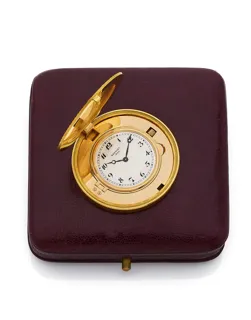
No. 1852 Circa 1926 Pocket watch inside a 5-pound 18k (750) yellow gold coin bearing the effigy of Queen Victoria. Case: round, fluted caseband, the back depicting a scene from the legend of Saint George slaying the dragon and dated 1887. Dial: opaline, Breguet numerals, railway minute track, signed. Movement: mechanical. Diameter: 36 mm. Gross weight: 36.30 g. With: a period case signed "Breguet, Horloger 2 rue Edouard VIII Paris". Provenance: B. family collection. Family heirloom, preserved by the descendants of the original owner. This watch is recorded in the archives of Breguet SA: "Sold on November 15, 1926 to René Bloch for 9800 francs". We thank Montres Breguet SA and especially Mr. Emmanuel Breguet for providing us with this information from the archives. An 18k yellow gold coin watch with a manual winding movement. It comes with a period fitted box. The present watch is registered in the archives of Breguet SA: “Sold on November 15, 1926, to René Bloch for 9,800 francs.” With our sincere thanks to Montres Breguet SA, especially to Mr. Emmanuel Breguet for his collaboration. Family inheritance, from the original owner. The year 1887 marks a major date in the history of the United Kingdom: the Golden Jubilee of Queen Victoria. To celebrate her fifty years on the throne, a series of commemorative coins were minted bearing her image. Made later, the coin watch presented here is among the rare horological memorabilia linked to this historical event. While major manufacturers such as Patek Philippe, Cartier, and Vacheron Constantin developed "coin watches" during the first half of the 20th century, Breguet emerged as a true pioneer in this field, as evidenced by this example dating from 1926. Other houses quickly followed: Cartier in 1927, then several workshops from 1929 onwards, thanks to the invention by Joseph Vergely, a watchmaker at the European Watch & Clock Co., of a system that perfectly concealed a tiny watch movement inside a coin. Through a discreet mechanism, activated by pressure on the edge, the coin opens to reveal a delicately integrated dial. Often made to order, these "coin watches" were among the most prized timepieces for royal families and the aristocracy. The year 1887 was particularly significant in the history of the United Kingdom, as it marked Queen Victoria's Golden Jubilee. To commemorate her 50 years on the throne, coins were minted bearing her image. This watch, made later, is one of the few souvenirs produced to mark this historic event. Family inheritance, from the original owner. The year 1887 marked a major milestone in the history of the United Kingdom: Queen Victoria's Golden Jubilee. To celebrate her fifty years on the throne, a series of commemorative coins bearing her image were minted. Produced later, the coin watch presented here is one of the few horological souvenirs linked to this historic event. While major manufacturers such as Patek Philippe, Cartier, and Vacheron Constantin developed “coin watches” during the first half of the 20th century, Breguet appears to have been a true pioneer in this field, as evidenced by this example dating from 1926. Other companies quickly followed suit: Cartier in 1927, then several workshops from 1929 onwards, thanks to the invention by Joseph Vergely, a watchmaker at the European Watch & Clock Co, of a system that allowed a tiny watch movement to be concealed inside a coin. Thanks to a discreet mechanism, activated by pressure on the edge, the coin opens to reveal a delicately integrated dial. Often made to order, these “coin watches” were among the most prized timepieces of royal families and the aristocracy.