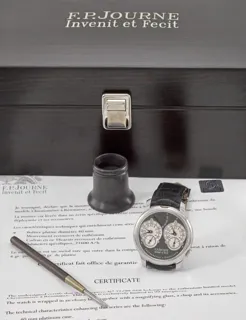
F.P. Journe. A very fine and rare platinum dual time chronometer wristwatch with resonance-controlled twin independent gear-train movement, power reserve, ruthenium-plated movement, certificate and box
F.P. Journe. A very fine and rare platinum dual time chronometer wristwatch with resonance-controlled twin independent gear-train movement, power reserve, ruthenium-plated movement, certificate and box
Signed F.P. Journe, Invenit et Fecit, Chronometre à Résonance, no. 72/99-01 R, circa 2003
Movement: cal. 1499-3, ruthenium-plated, manual, 37 jewels, signed
Dial: ruthenium-plated 18K gold, signed
Case: glazed display back secured by six screws, winding crown at 12 o'clock, seconds hands synchronized by the crown at 4 o'clock, 40 mm. diam., signed
With: platinum F.P. Journe buckle, original Certificate dated 8 October 2003, ebony magnifying glass, screw driver, original fitted wooden presentation box and outer packaging
,
Many of the watches offered for sale in this catalogue are pictured with straps made of endangered or protected animal materials such as alligator or crocodile. These endangered species straps are shown for display purposes only and are not for sale. Christie’s will remove and retain the strap prior to shipment from the sale site. At some sale sites, Christie’s may, at its discretion, make the displayed endangered species strap available to the buyer of the lot free of charge if collected in person from the sale site within 1 year of the date of the sale. Please check with the department for details on a particular lot.This endangered species strap is shown for display purposes only and is not for sale. The watch will be supplied with a calf leather strap. Consigned by a private Swiss collector the present Chronomètre à Résonance is preserved in very good overall condition. It is no. 72 of the limited edition of the Chronometre à Résonance “Ruthenium” model, produced between 2001 and 2003, numbered 1 to 99. The Chronomètre à Résonance is one of the exceedingly rare and fascinating timepieces based on resonance, a natural physical phenomenon. The two closely positioned balance wheels synchronize each other by means of the resonance effect and naturally beat alternately. The negative effects of wrist and body movements are hence considerably reduced. The effects of resonance upon a timekeeper was first noticed by Antide Janvier around 1780 who made clocks with two pendulums beating in resonance. The idea was taken further by Abraham Louis Breguet who successfully completed pocket watches with twin resonant balances. Ruthenium is the sovereign among precious metals. Derived from platinum, its sheer rarity means it can only be used for certain limited series and exceptional creations, such as the Chronomètre à Résonance.