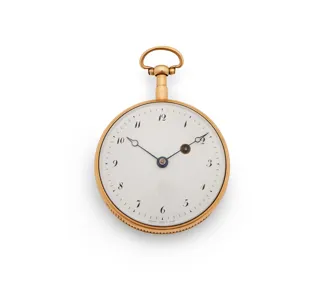
A FRENCH 18CT GOLD QUARTER-REPEATING WATCH INSCRIBED AS BEING A PRIZE FROM THE BATTLE OF WATERLOO
A FRENCH 18CT GOLD QUARTER-REPEATING WATCH INSCRIBED AS BEING A PRIZE FROM THE BATTLE OF WATERLOO
LEBAUTE CADET, NANCY, CIRCA 1815
The frosted gilt full-plate single fusee movement with three columnar pillars pinned through the backplate and verge escapement regulated by sprung brass three-arm balance with Tompion type regulation, with 'ting-tang' repeat for the hours and quarters on a graduated pair of gongs on depression the pendant, the backplate applied with delicate foliate scroll pierced rosette balance bridge and silver ADVANCE/RETARD regulation adjustment disc opposing decorated mainspring retention plate to the centre, flanked by V/L adjustment sector scale opposing signature Lebaute Cadet A NANCI engraved in a curve, the circular white enamel dial with vertically orientated Arabic hour numerals delicate blued steel moon hands and signed in tiny script LEBAUTE CADET A NANCI to lower edge, the case with an engraved inscription Prise a Waterloo, par Joseph Petty, Soldat du 3'me Bataillon, des Carabiniers, Le 18 Juin 1815, et presentee, au L't D, Macfarlane to the inside of the gilt cuvette and signed again Lebaute Cadet, A NANCI to the reverse, the exterior with hinged convex glazed front cover opposing sunburst decorated rear cover incorporating oval cartouche engraved L't D, Macfarlane, Rifle Corps to the lower margin, with ribbed band to circumference fitted with push-repeat pendant post incorporating hinged bow at twelve o'clock, the inside rear cover stamped with an assay mark, initials PHPI , serial number 5162 and K18 .
The backplate 4cm (1.5625ins) diameter; the case 5.2cm (2ins) diameter.
Provenance:
Previously sold at Christies, South Kensington sale of WATCHES 17 th December 2003 (lot 42) for £1,880.
The engraved inscription to the cuvette of the present watch would suggest that the present lot was taken as a prize at Waterloo by Joseph Petty, a soldier of the 3rd Battalion of Carabiniers and then presented to Lieutenant Dugald Macfarlane.
On the lead-up to Waterloo Lieutenant Dugald Macfarlane was attached to the 1 st Battalion 95 th Rifle Corps as commander of Captain Glass's Company. However, for the battle itself, he commanded Captain Fullerton's company of the third Battalion (95th), and was thus attached to the 3rd Light Brigade, Sir Harry Clinton's 2nd Division, Lord Hill's 2nd Corps, commanded by Sir Frederick Adam. During the battle Lieutenant Macfarlane found himself in the thick of the action with an account in his own words subsequently published in the Army and Navy Gazette:
'...was the right centre of the British army, on a sloping bank between Hougoumont and La Haye Sante, in squares of battalions, exposed for over six hours to the enemy's round shot, shell, and grape, and having to repel a dozen charges of his Cuirassiers and Lancers. About half-past 7 in the evening Lord Wellington galloped up to Sir Frederick Adam, and after a moment's interview we were ordered to form a line in crescent, with our flanks well in advance. Soon after we got into position, Marshal Ney, the most renowned soldier in France, came direct upon us at the head of seven battalions of the Old Imperial Guard, that had not fired a shot until then reserved evidently to break through in our centre and open out in our rear-Napoleon's favorite mode of securing a victory. They fought three deep in their companies, and in close columns in rear of their Grenadiers, with a frontage of only thirty men. Our flank battalions were formed two deep, and the 52nd in our centre was obliged to form four deep for want of room.
Our strength at this time was about 2400 men, thus occupying a frontage of about 300 yards, while Ney's seven battalions had only 100 yards' frontage, with wide intervals between each phalanx. They charged, drums beating, and cheering 'Vive l'Empereur!' and when within 150 yards we were ordered to commence a steady fire by volleys of companies, and after seven or eight rounds of those well-directed volleys the whole of the enemy were in utter confusion. Ney's horse was shot under him. He lost his cap and on foot, sword in hand, he endeavored to rally his men. This was impossible, they were treading each other down. We were ordered by Sir Frederick Adam to charge with the bayonet, and in a moment about 3000 of the enemy threw down their arms and rushed in the greatest confusion to the rear. At this moment we were over 100 yards in front of the British line, pursuing this routed multitude with Napoleon's favorite Marshal in their midst, and perfect masters of everything in our front.
The left of the 2nd Battalion Rifle Brigade had now reached the high road a little below La Belle Alliance, and shooting the horses of the enemy's artillery flying to the rear, blocked up the road, and thus secured about eighty guns of Count Reille and Count d'Erlon s corps. About 2000 of the enemy, under General Cambroune, were posted in front of La Belle Alliance to cover the retreat. They got panic-struck, and, adding disaster to confusion, fled with the Old Guard. Cambroune was taken prisoner by Lieutentant-Colonel Hugh Halkett, and we drove this routed mass a short distance beyond La Belle Alliance, when the Prussians took up the pursuit. It was now getting dark. We were halted, and ordered to take ground to our right, and slept upon the field, where Count d'Erlon's men had bivouacked the night before.'
After Waterloo Lieutenant Dugald Macfarlane retired form the army, married and settled in Neuchâtel (near Rouen) with his first wife, Jane Drummond; sadly she subsequently died giving birth to his fourth child who also did not survive.
Full the remainder of the catalogue description please follow the link below:
https://www.dreweatts.com/lot-103-fine-clocks-barometers-and-scientific-instruments-including-the-michael-finnemore-collection-14784/