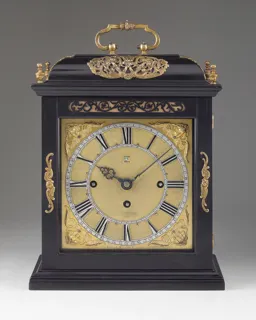
Joseph Knibb, Charles II Grande Sonnerie Table Clock, circa 1682-85
A very fine and rare Charles II ebony and gilt-brass mounted Phase III double-six Grande Sonnerie striking table clock with skeleton dial, circa 1682-85.
Height : 12¼ inches
Case : The archetypal Phase III case with ebony veneers and mouldings onto an oak carcass. The cushion-domed top with cast gilt-brass acanthus mounts to the front and sides and surmounted by Knibb’s own foliate-tied gilt-brass handle. The flat-top cornice moulding with foliate-urn finials to each corner, above a square front door with typical cast and chased S-scroll escutcheons to the vertical rails, the left pin-hinged, and a silk-backed pierced ebony fret to the top rail, the sides with rectangular glazed apertures. The base has conforming plinth mouldings, typically and correctly, without feet
Dial : The 6¾ inch square fire-gilded brass dial, signed along the lower edge Joseph Knibb London and the corners applied with Knibb’s later pattern of cast and chased gilt-brass winged cherub spandrels.
The very fine close edge matting extending behind the delicate skeletonised chapter ring with pierced Roman hours and dot half-hour markers, with every Arabic minute engraved within the division ring. The centre set with a chamfered date square below XII, three winding apertures, and archetypal finely pierced and chamfered blued-steel hands. The dial is fixed to the movement by four latched dial feet, and to the case by two typical screw-turns to the back, at III and IX, into the carcass behind the mask
Movement : The massive but delicate plates have ten latched vase-shaped pillars, the triple-split frontplate is divided for each train, holding their individual wheelwork, fusees and barrels, now with later chains. The going train has a knife-edge verge escapement with short brass pendulum rod and pearshaped adjustable bob. The IX side quarter strike train is governed by a small outside countwheel, quarterslotted for the detent lever, engraved 1-4, and with four pins to lift the pivoted link lever and trip the hours. The III side hour train with massive brass countwheel, divided to strike the hours at all quarters and twice engraved 1-6 at each hour (four times for every quarter), and pin-fixed to the fusee arbor. The fully engraved backplate has fine symmetrical scrolls and foliage with open and closed tulip flower heads, and is signed Joseph Knibb Londini fecit in the lower centre, all framed within a single line. The movement is further secured, in the early manner, by two pins resting against the backplate into the seatboard
Provenance : Private collection Devon, sold at Bearnes of Torquay, auctioneers, 9 March 1995;
Vitale collection, New York, USA, sold Christie’s 26 November 1996 for £84,000;
Private collection UK;
Anthony Woodburn and sold 2003;
Private collection UK