Everywatch

Rolex GMT-Master 1675

Description

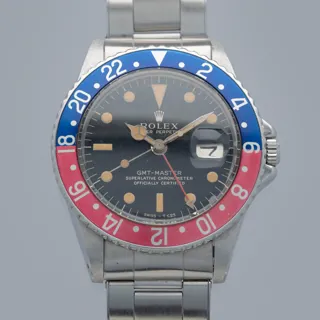
Rolex GMT-Master 1675 Gilt Dial Small 24 Hr Hand with Service Papers

Released in 1954, the Rolex GMT-Master resulted from a collaboration between now-extinct airline Pan Am and Rolex on a watch that would display the time across two time zones at once. Thanks to the popularisation of commercial air travel, planes were becoming more advanced and traveling longer distances. This resulted in pilots crossing time zones during flights more frequently, and thus a need for uniformity across the aviation industry was highlighted. To eliminate errors caused by time confusion, the industry adopted a standard time-zone, Greenwich Mean Time. As such, the GMT-Master's fourth hand, its 2nd hour hand, was used to constantly display Greenwich Mean Time, as its model name implies, while its regular hour hand displayed local time. While the aviation industry's standard time-zone switched to Coordinated Universal Time (UTC) in 1972, the name of the legendary GMT-Master was far too long in use for Rolex to change it. Today, the GMT-Master has become one of Rolex's most iconic models, with very few pilot's watches, if any, rivaling its level of fame, popularity, or signature design – and it certainly looks like it will stay that way.

Collectible Features |Rolex GMT-Master 1675

Discover all the different variants of this specific reference that can enhance, or limit, this watch's value and collectability.
Tropical Dial
A dial that has aged from black to a brown or caramel color due to prolonged exposure to sunlight and elements. Highly prized for its unique and attractive aging. Greatly increases value due to unique appearance and collector demand.
Gilt Dial
Dial with gold-colored text and markers. Common in older, vintage models. Adds value due to vintage appeal and aesthetics.
Serpico y Laino
Dials co-branded with the name of a famous Rolex retailer in Venezuela.

Similar Watches