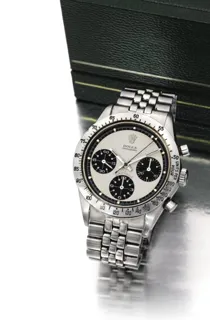
A STAINLESS STEEL CHRONOGRAPH WRISTWATCH WITH REGISTERS AND BRACELET
REF 6262 CASE 2528969 DAYTONA 'PAUL NEWMAN' CIRCA 1970
Rolex A STAINLESS STEEL CHRONOGRAPH WRISTWATCH WITH REGISTERS AND BRACELET
REF 6262 CASE 2528969 DAYTONA 'PAUL NEWMAN' CIRCA 1970 stainless steel diameter 36.5 mm, bracelet circumference approximately 165 mm , • cal. 727 manual winding nickel lever movement, 17 jewels, mono-metallic compensation balance • white and black dial, applied square indexes with luminescent dots, luminescent baton hands, black engine turned subsidiary dials for constant seconds, 30-minute and 12-hour registers, outer minute and 1/5 second divisions • stainless steel Oyster case with screw down crown and case back, bezel calibrated for 200 units • case, dial, and movement signed • with a stainless steel Rolex Jubilee bracelet and folding claspRolex, Estimate
60,000 - 90,000 USD
, Sold
, Rolex A STAINLESS STEEL CHRONOGRAPH WRISTWATCH WITH REGISTERS AND BRACELET
REF 6262 CASE 2528969 DAYTONA 'PAUL NEWMAN' CIRCA 1970 stainless steel diameter 36.5 mm, bracelet circumference approximately 165 mm , • cal. 727 manual winding nickel lever movement, 17 jewels, mono-metallic compensation balance • white and black dial, applied square indexes with luminescent dots, luminescent baton hands, black engine turned subsidiary dials for constant seconds, 30-minute and 12-hour registers, outer minute and 1/5 second divisions • stainless steel Oyster case with screw down crown and case back, bezel calibrated for 200 units • case, dial, and movement signed • with a stainless steel Rolex Jubilee bracelet and folding clasp, Accompanied by two additional Rolex Jubilee bracelet links, a pamphlet, and a presentation box. Beginning in the late 1960s, Rolex offered special "exotic" dials on their Cosmograph Daytona models. Years later, watches with these dials became known as Paul Newman models, since the actor is presumed to have worn one in the 1969 auto racing film Winning .
The Paul Newman dial is characterized by square markers in the chronograph scale and subsidiary dials, in addition to the alternating coloration patterns. Although they were widely available at the time, these dials were produced in smaller numbers and are rarer to find.
The Calibre 727 is the evolution of Calibre 722-1. Rolex improved the Calibre's performance by changing the balance from 18'000 to 21'600 vibrations per hour, which noticeably increased the precision.
The Calibre 727 is illustrated in Carlo Pergola, Stefano Mazzariol & Giovanni Dosso, Rolex Daytona: A Legend Is Born , 2006, p. 122–125.