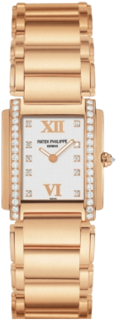
Patek Philippe Twenty-4 4908/11R-011 ‘Ladies’ Rose Gold White Diamond Dial Diamond Bezel Quartz
Learn more The Twenty~4 was introduced in 1999 as Patek Philippe's explicit statement about what a luxury lady's watch should be in the context of late twentieth-century collecting — not a smaller dress watch scaled from the Calatrava tradition, not a feminized adaptation of a men's complications reference, but a watch conceived from the outset as a daily wear object for the modern woman, one that combined the formal elegance of the rectangular case with the material confidence of a full precious metal bracelet and the practical precision of a quartz calibre. The design's central proposition was that a watch can be worn every day without reservation — at work, at dinner, at the beach within its water resistance limit — and still represent Patek Philippe's full material and technical standard. The reference 4908/11R-011, the Twenty~4 small case in rose gold with the "Timeless White" dial configuration — diamond bezel channels set into the case sides, diamond hour markers, Roman numeral XII and VI in applied polished rose gold, integrated rose gold bracelet — is that proposition at its most precisely calibrated. It is the smallest, most intimate, and most purely jewellery-oriented of the Twenty~4 reference family's current expressions, and it represents, within a format that has been continuously produced since the collection's launch, the specific configuration that has proven most enduring.
The Twenty~4 collection exists in two case sizes: the standard format, introduced with the original launch in the 4910 reference family, and the small case format of the 4908 reference family. The 4908 measures 22 millimeters horizontally by 26.3 millimeters vertically — a format that is, at these dimensions, firmly in the territory of jewellery watchmaking rather than watchmaking that happens to use precious materials. At 22 by 26.3 millimeters, the watch occupies the wrist with a presence that is more akin to a fine bracelet that includes a timepiece than to a watch that is accompanied by a bracelet. The integration of case and bracelet, which is the Twenty~4's most fundamental design decision, is at its most physically complete at the small case's dimensions: the bracelet's three-link construction, whose links taper in width toward the case attachment points, matches the case's own vertical dimension with a precision that makes the transition invisible, the watch flowing from the bracelet as a natural continuation rather than as an applied element. In rose gold, this integration produces the particular visual effect of the Twenty~4 at its most feminine and most precious: a warm, continuous gold surface wrapping the wrist with the bracelet's complex link structure on either side and the dial's white and diamond composition at the center.
The case sides — the narrow vertical faces of the rectangular case, running parallel to the bracelet on both left and right — are set with brilliant-cut diamonds in channel settings, the stones running the full height of the case side in a continuous line that frames the dial from the bracelet junctions downward. Thirty-four diamonds totaling approximately 0.43 carats occupy these four channel settings, their combined presence producing the watch's defining visual accent: from the front, the diamonds at the case sides register as two thin flanking columns of cool white light against the rose gold case, the stones' spectral brilliance providing the compositional balance that frames the warm dial between two cooler, more active elements. The crown at three o'clock is set with a single diamond of approximately 0.05 carats — a detail of characteristic Patek Philippe precision, the crown stone functional in the sense that it caps the winding interface but primarily present as the compositional completion of the watch's diamond program, ensuring that no element of the watch's surface is left without the specific quality of finish that the overall design demands.
The "Timeless White" dial — one of the Twenty~4's classic dial configurations, its name describing the off-white to ivory quality of the dial ground rather than a purely neutral white — carries a composition of considerable restraint and considerable material intelligence simultaneously. Diamond hour markers occupy ten of the twelve hour positions — individual brilliant-cut round stones set into the dial surface at each minor hour position, their cool light providing the dial's primary index structure. At twelve o'clock and six o'clock, applied polished rose gold Roman numerals — XII and VI in the heavy, classical letterform that Patek Philippe applies across its most formal dial designs — occupy their positions with the warm brightness of the rose gold against the pale dial ground, the two numerals providing the dial's vertical axis and the only warm-colored elements in an otherwise cool-and-white composition. Rose gold lancet hands — their slim, tapered forms calibrated to the 22 by 26.3-millimeter dial's available space — provide the time display with the delicacy appropriate to a watch of this scale.
The movement is the Calibre E15, Patek Philippe's quartz calibre for the Twenty~4 family: 57 parts, 6 jewels, battery-powered, its battery accessed through the solid rose gold caseback. The quartz calibre in the Twenty~4 context is not a concession to practical constraints but the correct movement for this specific watch — a daily-wear ladies' watch whose primary identity is as a piece of personal adornment, whose wearer does not wind a watch each morning or perform the ritual attentiveness that a mechanical movement requests, and whose accuracy standard is absolute rather than "within plus or minus two seconds per day." The Calibre E15's precision is unconditional: it does not vary with position, temperature, or the interval since its last winding. For a watch worn without interruption as a continuous piece of personal jewelry, this is the appropriate technical provision.
The rose gold integrated bracelet — three-link construction with alternating brushed and polished surfaces on the individual links, the brushed and polished surfaces creating the visual texture that distinguishes a quality bracelet from a smooth one — deploys via a hidden butterfly clasp integrated into one of the bracelet's links without visible seam. The clasp's invisibility is among the bracelet's most craft-intensive achievements: the mechanism that allows the clasp to open and close is entirely contained within the link's profile, the clasp's presence perceptible only when the specific link is flexed in the particular direction that activates the release. This quality — the clasp as a hidden mechanism rather than a visible deployment point — maintains the bracelet's visual continuity around the full wrist circumference and is itself a statement about what the Twenty~4 represents as an object: a piece of jewelry whose functional features are resolved so completely into the design that they become invisible.
The reference 4908/11R-011 is, for the collector of ladies' fine watches, one of the most consistently right answers that Patek Philippe has provided since the Twenty~4's 1999 introduction. It does not change from season to season; it does not require any concession to current taste because it was designed for endurance rather than currency; and it occupies the specific position in the fine watch spectrum — between the purely decorative jewellery piece and the genuinely worn daily watch — with a precision that the Twenty~4's two-decade-plus production history has confirmed rather than undermined. The small rose gold case with the Timeless White dial is the watch for the wearer who has decided that daily wearing a piece of this quality is the highest use to which such an object can be put.