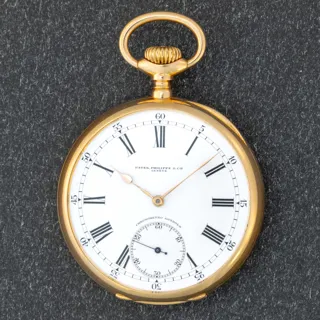
Patek Philippe Pocket watch, made for the Brazilian market, retailed by Gondolo & Labouriau, enamel dial; “Chronometro Gondolo”; (18-carat) Pink gold
Brand Patek Philippe, Geneva
Model “Chronometro Gondolo”
Retailed by Especially made for and retailed by Gondolo & Labouriau, Rio de Janeiro (Brazil)
Year Circa 1912-1914
Reference - Movement No. 177 288
Calibre 20, manual-winding, 20 jewels
Case No. 279 983
Materials (18-carat) Pink gold
Bracelet -
Buckle -
Dimensions Ø 56.1 mm
Thickness 13.7 mm
Length -
Weight 127.7 gr (approx.)
Signature Dial, case and movement
Accessories - Patek Philippe
Pocket watch, made for the Brazilian market, retailed by Gondolo & Labouriau, enamel dial; “Chronometro Gondolo”; (18-carat) Pink gold (18-carat) Pink gold, open-face, keyless-winding, round-shaped, “Chronometro Gondolo” pocket watch, made for the Brazilian market, with subsidiary seconds at 6 o’clock. Case: four-piece, “Bassine”, polished; gold cuvette (dome) engraved in taille-douce (fine cut) with the manufacturer’s name and serial number, as well as the name of the retailer (with the mention “chronometro gondolo / Fabricado expressamente para Gondolo & Labouriau Relojoeiros / rio-de-janeiro”); oval-shaped clipped bow. Case-back guilloché (engine-turned), with, in the centre, a plain medallion. Dial: white colour enamel, with black painted radiating Roman numerals; external minute track divided five by five with black painted radiating Arabic numerals and lines; yellow gold “Poire Stuart” pear-shaped hands. Movement: calibre 20, manual-winding, 20 jewels, gilded brass, going barrel, gold train of wheels, straight-line equilibrated lever escapement, à moustaches, cut bimetallic compensated balance with gold poising screws, blued steel hairspring with terminal curve, patented polished steel index-regulator with swan-neck spring and precision-regulating device for fast / slow by means of an eccentric snail. Type of winding and time setting: winding and time-setting by the crown on the pendant. Movement based on the French invention patent No. 142 376, delivered on April 16 1881, Geneva, for a “Régulateur de precision” (precision-regulating device for fast / slow by means of an eccentric snail). Movement also based on the Swiss invention patent No. 2 680, delivered on September 27 1890, to Patek, Philippe & Cie, Geneva, for a “Remontoir avec mise à l’heure perfectionné” (the definitive version of the keyless-winding and setting device). And also based on the US design patent No. 20 483, delivered on January 13 1891, to Adrien Philippe, Geneva, for a “Watch bridges for Watch-Movements”.