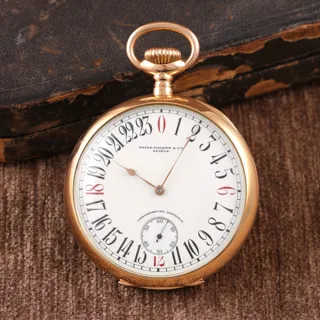
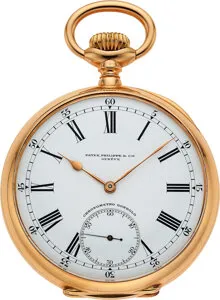
PATEK PHILIPPE Patek Philippe & Cie, Genève, Chronometro Gondolo, movement no. 126342, case no. 234281, circa 1908
PATEK PHILIPPE
Patek Philippe & Cie, Genève, Chronometro Gondolo, movement no. 126342, case no. 234281, circa 1908
A fine and attractive, large, keyless, 18K pink gold pocket watch with 24-hour white enamel dial (slightly chipped at 23 under bezel), radial black Arabic numerals, red quarter numerals, gold Spade hands, small second at 6.
Fitted with a Patek Philippe first quality movement, keyless, hand wound, frosted gilt finish, straight line lever escapement, index regulator with fine adjustment, wolf’s tooth winding, self-compensating blued steel Breguet hairspring, cut-bimetallic balance with timing screws, mustache anchor, gold wheel train, engraved “PAT JAN 13, 1891” for the patented winding and setting time mechanism, gold hinged cuvette, gold hinged back cover, mineral glass.
Dial, case, cuvette and movement signed.
Diam. 56 mm. Thickness 15.85 mm.
Accompanied by a fitted PP presentation box.
Between 1902 and the early 1930s, Patek, Philippe & Cie produced high quality watches of precise esthetic and technical characteristics exclusively for its Brazilian agent in Rio de Janeiro, Gondolo & Laboriau. These watches bore the name “Chronometro Gondolo”.
On March 10 1902, at 8 o’clock in the morning, the name “Chronometro Gondolo” was registered under the number 14'401. Several variations were offered: different types of cases (gold, silver, or niello silver); of dials (a choice of 12 hour or 24 hour indications) and of hands. The diameter of the pocket watches ranged from 32 to 57 mm. The dimensions of the movements varied between 10 and 22’’’, or the equivalent of 22,5 to 50 mm.
The movements of Chronometro Gondolo watches were required to possess the following technical characteristics: - An ebauche based on a drawing registered by Adrien Philippe (US patent N° 20483 of January 13, 1891) with wolf tooth winding and a crown. - François Wilmot's patented micrometric cam regulator (US patent No 129197 registered on July 16, 1872). - A 9K gold train. - A straight line "moustache" lever escapement with cut bimetallic compensation balance and a Breguet balance spring. - A minimum of 18 jewels (there were either 18, 19, 20 or 21 jewels).