Patek Philippe Golden Ellipse 4126/1 White Gold Blue Diamond Dial Diamond Bezel
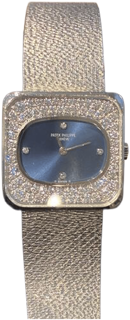
The Patek Philippe Golden Ellipse 4126/1 represents the reference at its most jewelry-intensive: a fully pavé-set diamond bezel encrusting the entire square-cushion surround of the case, with only the inner oval dial frame emerging from the diamond surface — a construction that transforms the watch from a precision instrument into an object of haute joaillerie while preserving the elliptical dial's legibility intact. The vintage white gold integrated bracelet with its characteristic hammered or grained surface texture is among the most recognisable integrated bracelet designs in the pre-modern Patek Philippe catalogue.
The 25mm white gold cushion-form case carries a fully pavé-set diamond bezel covering the entire square surround, with a polished inner frame isolating the oval blue sunburst dial. The blue dial presents four diamond hour markers at twelve, three, six, and nine o'clock, with yellow gold dauphine hands. The white gold integrated bracelet features an overall textured grain finish flowing continuously from the case flanks. A Swiss manual movement powers the watch.
Learn more The late 1960s and early 1970s represent one of the most formally adventurous periods in Patek Philippe's production history — a moment when the manufacture, long associated with the round Calatrava case's restrained perfection, began exploring the shaped watch with a seriousness of purpose that produced several of the most beautiful wristwatch designs of the twentieth century. The Golden Ellipse, introduced in 1968, was the most enduring of these shaped explorations, its case proportions derived from the golden ratio of 1:1.2762 producing an oval of such formal rightness that it has remained in continuous production for more than fifty years. The reference 4126/1 belongs to the Golden Ellipse family's vintage production in a specific and particularly compelling configuration: a cushion-shaped — rather than strictly oval — case form in 18-karat white gold with a diamond-set bezel, a cobalt blue sunburst dial with diamond hour markers at the quarter positions, and an integral bark-finish white gold bracelet of the type that the early 1970s elevated into one of the most distinctive objects in fine jewellery watchmaking. Powered by the manually wound Calibre 13.5, this is an object of the era of its making — specifically and unmistakably of the high-jewellery watch tradition of 1970s Geneva — that looks at no other time more right than it does now.
The case form of the 4126/1 requires a moment of attention, because it occupies an interesting position within Patek Philippe's shaped watch vocabulary of the period. Where the Golden Ellipse's standard production was premised on the pure oval — the elliptical case whose horizontal and vertical axes are in the golden ratio — the 4126/1 employs a cushion form: a square whose corners have been rounded to produce a shape that sits between the square and the circle, the four sides flat and the four corners curved. This form was common in the fine watchmaking production of the 1960s and 1970s, sharing design lineage with Patek Philippe's own cushion-case references of the period and with the broader shaped-watch movement that characterized Swiss and French luxury watchmaking across the era. At 25 millimeters, the cushion case is small — a ladies' scale, its dimensions appropriate to the watch's identity as jewellery rather than as a timekeeping instrument primarily — and the 18-karat white gold's surface provides the cool, silver-grey tone that sets off the cobalt blue dial and the diamonds with the chromatic neutrality that neither yellow gold nor platinum achieves in precisely the same way.
The diamond setting on the reference 4126/1 operates at two levels simultaneously, and the relationship between the two levels constitutes the watch's primary decorative achievement. The bezel — the immediate framing element between the case's outer edge and the dial — is set with diamonds in a continuous pavé: numerous brilliant-cut rounds covering the bezel face completely, without gap or interruption, the collective surface a field of spectral white fire that surrounds the blue dial like a halo of cool light. At 25 millimeters, the bezel's diamond field occupies a significant proportion of the total watch surface, and in the early 1970s setting style — individual stones closely placed, their combined brilliance building to a collective brightness that the 1980s' more systematized pavé approaches would later refine further but never fundamentally improve — the effect is lavish without being heavy, the diamonds providing brilliance that belongs to the object's specific visual moment rather than to any more recent production approach. Below the bezel's outer diamond ring, the cobalt blue sunburst dial carries diamond-set markers at the four quarter-hour positions — twelve, three, six, and nine o'clock — their individual stones smaller than the bezel's but set with the same precision, the quarter-hour positions marked in diamonds while the remaining hours are unmarked. The result is a dial of unusual compositional restraint: most of its surface the pure cobalt blue of the lacquered sunburst ground, punctuated only at the four cardinal positions by the cool light of the diamond markers.
Cobalt blue at this period of Patek Philippe production carries a specific historical authority. The deep, saturated blue that characterized the Golden Ellipse and related references of the late 1960s and early 1970s — what collectors often describe as "electric blue" or "cobalt" to distinguish it from the more varied blues available in contemporary production — was a dial color of remarkable clarity and depth, its lacquer formulation producing a surface that absorbs and returns light with the specific quality of a very fine blue pigment rather than the cooler, more metallic blue of sunray-brushed or galvanized dials. Against the white gold case and the diamond bezel's spectral fire, this cobalt blue provides a warmth of color that prevents the composition from reading as entirely cool — the blue's warmth against the diamond and white gold's coolness creating the same productive chromatic complementarity that fine jewellery achieves when it pairs warm and cool materials deliberately. The polished pointed baton hands in what the archive description records as "rose gold color" — a gentle warmth against the blue ground — complete the dial's time display with the delicacy appropriate to a case of this scale.
The movement is the Calibre 13.5, Patek Philippe's manually wound ladies' calibre of the period — a 20-jewel movement adjusted to heat, cold, isochronism, and five positions, whose manual winding character at this scale is not a concession to space constraints but is consistent with the watchmaking traditions that defined fine ladies' jewellery timepieces of the era. At a period when quartz movements were beginning to appear in luxury watchmaking, a manually wound mechanical calibre in a fine jewellery watch represented a continued commitment to the tradition of horological quality regardless of the dominant commercial direction, and the 4126/1's Calibre 13.5 carries that tradition within a case whose exterior identity is entirely jewelry while its interior identity remains entirely watchmaking.
The integral bark-finish white gold bracelet is, alongside the diamond bezel and the cobalt blue dial, the reference 4126/1's defining physical element. Bark finish — the technique of creating a textured surface on gold that resembles the irregular, linear grain of tree bark — was among the most distinctive metal finishing approaches of the 1960s and 1970s ladies' watch and jewellery bracelet tradition, its random, directional texture providing visual warmth and dimensional complexity quite different from the smooth polish or woven mesh finishes of conventional precious metal bracelets. The bark-finish white gold, slightly matte and irregular in its light behavior, produces a surface of quiet richness — warmer in appearance than polished white gold despite sharing the same material, the texture's depth absorbing directional light and returning it diffused. The bracelet is integral in the 1970s manner: the links engineered specifically to flow from the case without gap or visual interruption, the transition from case to bracelet achieved with the seamlessness that Patek Philippe's bracelet engineering of the period consistently achieved. The folding clasp closes the bracelet with the practicality appropriate to a jewellery timepiece intended for daily wear.
The 4126/1 is, for the contemporary collector, an object of several convergent pleasures. It is rare in the sense that all well-preserved early 1970s Patek Philippe ladies' bracelet watches are rare — the survival of the integral bracelet in original condition, the maintenance of the original dial's cobalt blue saturation, the preservation of the diamond settings' security and alignment. It is beautiful in the sense that the best objects of its era are beautiful — not in the manner of a watch designed after the development of contemporary aesthetic standards, but in the manner of something made to the aesthetic standards of its own moment, which are different and which produce a visual character that contemporary production cannot reproduce without pastiche. And it is historical in the sense that it belongs to the decade when Patek Philippe first demonstrated the full range of what its production could achieve when formal ambition and jewellery achievement were pursued simultaneously and without compromise.
Reference Number 4126/1 Model Family Golden Ellipse Movement Manual Winding Case Material White Gold Bracelet Material White Gold Dial Blue Case Dimension 25mm Year Condition Pre-Owned (Very Good) Box & Papers No Original Box, No Original PapersLearn more The late 1960s and early 1970s represent one of the most formally adventurous periods in Patek Philippe's production history — a moment when the manufacture, long associated with the round Calatrava case's restrained perfection, began exploring the shaped watch with a seriousness of purpose that produced several of the most beautiful wristwatch designs of the twentieth century. The Golden Ellipse, introduced in 1968, was the most enduring of these shaped explorations, its case proportions derived from the golden ratio of 1:1.2762 producing an oval of such formal rightness that it has remained in continuous production for more than fifty years. The reference 4126/1 belongs to the Golden Ellipse family's vintage production in a specific and particularly compelling configuration: a cushion-shaped — rather than strictly oval — case form in 18-karat white gold with a diamond-set bezel, a cobalt blue sunburst dial with diamond hour markers at the quarter positions, and an integral bark-finish white gold bracelet of the type that the early 1970s elevated into one of the most distinctive objects in fine jewellery watchmaking. Powered by the manually wound Calibre 13.5, this is an object of the era of its making — specifically and unmistakably of the high-jewellery watch tradition of 1970s Geneva — that looks at no other time more right than it does now.
The case form of the 4126/1 requires a moment of attention, because it occupies an interesting position within Patek Philippe's shaped watch vocabulary of the period. Where the Golden Ellipse's standard production was premised on the pure oval — the elliptical case whose horizontal and vertical axes are in the golden ratio — the 4126/1 employs a cushion form: a square whose corners have been rounded to produce a shape that sits between the square and the circle, the four sides flat and the four corners curved. This form was common in the fine watchmaking production of the 1960s and 1970s, sharing design lineage with Patek Philippe's own cushion-case references of the period and with the broader shaped-watch movement that characterized Swiss and French luxury watchmaking across the era. At 25 millimeters, the cushion case is small — a ladies' scale, its dimensions appropriate to the watch's identity as jewellery rather than as a timekeeping instrument primarily — and the 18-karat white gold's surface provides the cool, silver-grey tone that sets off the cobalt blue dial and the diamonds with the chromatic neutrality that neither yellow gold nor platinum achieves in precisely the same way.
The diamond setting on the reference 4126/1 operates at two levels simultaneously, and the relationship between the two levels constitutes the watch's primary decorative achievement. The bezel — the immediate framing element between the case's outer edge and the dial — is set with diamonds in a continuous pavé: numerous brilliant-cut rounds covering the bezel face completely, without gap or interruption, the collective surface a field of spectral white fire that surrounds the blue dial like a halo of cool light. At 25 millimeters, the bezel's diamond field occupies a significant proportion of the total watch surface, and in the early 1970s setting style — individual stones closely placed, their combined brilliance building to a collective brightness that the 1980s' more systematized pavé approaches would later refine further but never fundamentally improve — the effect is lavish without being heavy, the diamonds providing brilliance that belongs to the object's specific visual moment rather than to any more recent production approach. Below the bezel's outer diamond ring, the cobalt blue sunburst dial carries diamond-set markers at the four quarter-hour positions — twelve, three, six, and nine o'clock — their individual stones smaller than the bezel's but set with the same precision, the quarter-hour positions marked in diamonds while the remaining hours are unmarked. The result is a dial of unusual compositional restraint: most of its surface the pure cobalt blue of the lacquered sunburst ground, punctuated only at the four cardinal positions by the cool light of the diamond markers.
Cobalt blue at this period of Patek Philippe production carries a specific historical authority. The deep, saturated blue that characterized the Golden Ellipse and related references of the late 1960s and early 1970s — what collectors often describe as "electric blue" or "cobalt" to distinguish it from the more varied blues available in contemporary production — was a dial color of remarkable clarity and depth, its lacquer formulation producing a surface that absorbs and returns light with the specific quality of a very fine blue pigment rather than the cooler, more metallic blue of sunray-brushed or galvanized dials. Against the white gold case and the diamond bezel's spectral fire, this cobalt blue provides a warmth of color that prevents the composition from reading as entirely cool — the blue's warmth against the diamond and white gold's coolness creating the same productive chromatic complementarity that fine jewellery achieves when it pairs warm and cool materials deliberately. The polished pointed baton hands in what the archive description records as "rose gold color" — a gentle warmth against the blue ground — complete the dial's time display with the delicacy appropriate to a case of this scale.
The movement is the Calibre 13.5, Patek Philippe's manually wound ladies' calibre of the period — a 20-jewel movement adjusted to heat, cold, isochronism, and five positions, whose manual winding character at this scale is not a concession to space constraints but is consistent with the watchmaking traditions that defined fine ladies' jewellery timepieces of the era. At a period when quartz movements were beginning to appear in luxury watchmaking, a manually wound mechanical calibre in a fine jewellery watch represented a continued commitment to the tradition of horological quality regardless of the dominant commercial direction, and the 4126/1's Calibre 13.5 carries that tradition within a case whose exterior identity is entirely jewelry while its interior identity remains entirely watchmaking.
The integral bark-finish white gold bracelet is, alongside the diamond bezel and the cobalt blue dial, the reference 4126/1's defining physical element. Bark finish — the technique of creating a textured surface on gold that resembles the irregular, linear grain of tree bark — was among the most distinctive metal finishing approaches of the 1960s and 1970s ladies' watch and jewellery bracelet tradition, its random, directional texture providing visual warmth and dimensional complexity quite different from the smooth polish or woven mesh finishes of conventional precious metal bracelets. The bark-finish white gold, slightly matte and irregular in its light behavior, produces a surface of quiet richness — warmer in appearance than polished white gold despite sharing the same material, the texture's depth absorbing directional light and returning it diffused. The bracelet is integral in the 1970s manner: the links engineered specifically to flow from the case without gap or visual interruption, the transition from case to bracelet achieved with the seamlessness that Patek Philippe's bracelet engineering of the period consistently achieved. The folding clasp closes the bracelet with the practicality appropriate to a jewellery timepiece intended for daily wear.
The 4126/1 is, for the contemporary collector, an object of several convergent pleasures. It is rare in the sense that all well-preserved early 1970s Patek Philippe ladies' bracelet watches are rare — the survival of the integral bracelet in original condition, the maintenance of the original dial's cobalt blue saturation, the preservation of the diamond settings' security and alignment. It is beautiful in the sense that the best objects of its era are beautiful — not in the manner of a watch designed after the development of contemporary aesthetic standards, but in the manner of something made to the aesthetic standards of its own moment, which are different and which produce a visual character that contemporary production cannot reproduce without pastiche. And it is historical in the sense that it belongs to the decade when Patek Philippe first demonstrated the full range of what its production could achieve when formal ambition and jewellery achievement were pursued simultaneously and without compromise. Wearing the 4126/1 is an encounter with that demonstration.