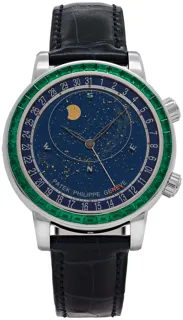
Patek Philippe Celestial Joaillerie Grand Complications 6104/13P-010 Platinum Blue Dial Emerald Bezel (2025)
The Grand Complications 6104/13P-010 represents ultra-rare out-of-catalogue variant reserved exclusively for Patek Philippe's most important collectors. The 60 baguette-cut emeralds totaling 3.92 carats distributed across bezel (38 stones, 3.04 carats) and platinum fold-over clasp (22 stones, 0.88 carat) provide vibrant green frame complementing blue celestial dial depicting nocturnal sky visible from Geneva latitude. Emerald variant's lower total carat weight versus sapphire (6.04 total carats) or ruby (5.66 total carats) reflects emeralds' lower density—stones cut to same approximate physical dimensions weigh less, though procurement difficulty and value premium far exceed corundum (sapphire/ruby) alternatives. The Celestial complication traces lineage to Patek Philippe's 1985 Reference 3874 Caliber 240 featuring astronomical indications, with modern 6104 series debuted 2002 offering rotating sky chart, moon phase orbit, and sidereal time within 44mm case powered by ultra-thin Caliber 240 LU CL C. The astronomical display presents exact configuration of nocturnal sky in northern hemisphere at any moment, apparent movement of stars and moon phases/orbit visible through rotating sapphire disk. The 44mm case measures 11.33mm thick despite housing complex astronomical complications, crafted entirely in 950 platinum with polished surfaces throughout maintaining classical elegance appropriate for grand complication dress watch positioning. The bezel set with 38 baguette-cut emeralds creates vibrant green border framing dial, each stone precision-cut to fit curved bezel geometry while maintaining uniform appearance and secure channel setting protecting stones during wear. Water resistance limited to 30 meters reflects dress watch orientation prioritizing case refinement over sports watch robustness, sapphire crystals front and back allowing unobstructed viewing of astronomical display and exhibition caseback revealing Caliber 240 LU CL C's architecture. Brilliant-cut diamond set at 6 o'clock position provides subtle accent complementing emerald bezel while maintaining symmetry. The rotating blue sapphire crystal disk depicts celestial map showing Milky Way, stars, and constellation patterns visible from Geneva and all cities at same latitude (approximately 46 degrees north), ellipse deposited on sapphire crystal's underside frames visible sky portion while disk rotates counterclockwise completing full revolution every 23 hours 56 minutes matching actual sidereal day (star time versus solar time). White gold skeletonized leaf-shaped hands indicate hours and minutes of mean solar time atop rotating celestial display, hands' openworked construction minimizing visual obstruction of star chart beneath. Moon phase indication shows lunar orbit and current phase through aperture with high precision requiring correction only once every 122 years, meridian passage of Sirius (brightest star in night sky) marked for astronomical reference. The self-winding Caliber 240 LU CL C measures 38mm diameter by 6.81mm thickness representing ultra-thin movement construction enabling relatively modest case profile despite complication complexity, movement comprises 315 components with 45 jewels operating at 21,600 semi-oscillations per hour (3Hz) with 38-48 hour power reserve. The 22k gold off-center mini-rotor enables automatic winding while maintaining movement thinness versus traditional central rotor, Gyromax balance ensures precision timekeeping through adjustable inertia blocks eliminating regulator index. The 'LU' designation indicates lunar (moon) complications while 'CL' signifies celestial (star chart) functions, movement finishing includes Geneva Seal standards with hand-beveled edges, circular graining, and polished steel parts visible through sapphire caseback. Hand-stitched shiny navy blue alligator leather strap with square scales complements celestial dial while platinum fold-over clasp set with 22 baguette-cut emeralds (0.88 carat) extends gem-set luxury beyond case, clasp's emerald integration creating cohesive jewelry presentation across entire timepiece visible even when worn.Learn more The Celestial represents Patek Philippe's poetic intersection between astronomical complications and haute joaillerie, joining timepieces displaying actual celestial mechanics (moon phase, astronomical calendar, planetarium) within decorative frameworks elevating watches beyond functional instruments into art objects. Patek Philippe's astronomical watch tradition traces centuries: 18th-century pocket watches displaying moon phases and astronomical calendars, 19th-century complications tracking sidereal time and celestial coordinates, culminating in 20th-century masterpieces like the Henry Graves Supercomplication (1933, featuring sky chart visible from New York) and contemporary Sky Moon Tourbillon (reference 6002, displaying celestial chart from Geneva on front dial, nocturnal sky with Sirius/moon meridian passage on reverse). The Celestial collection debuted 2002 with reference 5102 introducing wristwatch format for sky chart complications previously confined to pocket watches or ultra-complicated models, 44mm case enabling sufficient dial real estate displaying rotating star map, moon orbit, Milky Way representation. The reference 6104 Celestial Joaillerie variants expand original astronomical concept through gemstone integration: diamond-set bezels appeared first, followed by colored gemstone editions (sapphire reference 6104/11P-010, ruby reference 6104/12P-010, emerald reference 6104/13P-010) introduced 2020s creating visual connection between colored stones and deep blue celestial dial. The reference 6104/13P-010 combines 38 baguette-cut emeralds in bezel (3.04 carats), additional 22 baguette emeralds in deployant clasp (0.88 carat), totaling 60 emeralds weighing 3.92 carats, platinum case/crystal construction, blue sapphire crystal sky chart dial, representing pinnacle expression where gemstone luxury meets astronomical complexity within Patek Philippe's Grand Complications catalog.
The 44mm x 11.33mm case fabricates entirely from 950 platinum (95% platinum, 5% ruthenium/iridium alloy creating hardness and workability), representing Patek Philippe's precious metal specification for haute joaillerie pieces. The substantial 44mm diameter proves essential accommodating complex astronomical dial display: rotating sky chart requiring 360-degree visibility, peripheral date scale encircling dial edge, moon phase disc and orbit indication needing unobstructed real estate, proportions enabling legibility of celestial features impossible in smaller cases. The case employs traditional round construction (versus tonneau or cushion shapes), polished surfaces throughout creating mirror-like platinum appearance, straight lugs flowing from case middle accepting 23mm strap width. Water resistance extends modest 30 meters reflecting dress watch positioning prioritizing dial complexity and gemstone setting over aquatic capability.
The bezel houses 38 baguette-cut emeralds weighing 3.04 carats total, rectangular step-cut stones arranged continuously around 44mm circumference creating unbroken green perimeter. Baguette cutting (rectangular outline, stepped parallel facets creating hall-of-mirrors effect, minimal brilliance versus round cuts but maximum color saturation) represents traditional choice for bezel setting: rectangular geometry enabling close placement without gaps, parallel facets creating uniform appearance, step-cut showcasing emerald's color rather than fire. The emeralds employ likely Colombian origin (Patek Philippe favoring Muzo/Chivor mines producing finest grass-green stones), vivid saturation without excessive darkness, eye-clean clarity (emeralds inherently included, "jardin" inclusions accepted, eye-clean stones requiring exceptional selection), consistent color matching across 38 stones (emerald color varying significantly requiring careful selection ensuring uniform green without yellowish/bluish tones).
The emerald setting employs channel mounting: continuous platinum channel encircling bezel, baguette emeralds fitted sequentially into channel, metal edges securing stones from sides preventing individual prong visibility, creating seamless green band interrupted only by stone-to-stone transitions. This setting maximizes emerald visibility (minimal metal obstruction), protects vulnerable emerald edges (brittleness requiring bezel protection versus exposed prong setting), creates unified appearance emphasizing continuous color rather than individual stones.
The sapphire crystal covers dial employing domed profile, anti-reflective coating reducing glare despite curved surface. Critically, the crystal's underside features engraved ellipse (oval outline) deposited on crystal interior framing visible sky portion from Geneva latitude 46°12'N—this ellipse represents horizon line: celestial bodies within ellipse visible above Geneva horizon at any given moment, stars outside ellipse below horizon. This Geneva-specific calibration makes watch personal to Swiss location, though sky chart remains accurate for any location along 46°N latitude (including cities like Bordeaux, Lyon, Montreal, Seattle).
The dial construction employs multiple sapphire crystal discs creating three-dimensional celestial representation. The background disc fabricates from blue sapphire crystal (corundum, aluminum oxide crystal colored by titanium/iron creating deep blue), creating night sky appearance—transparent blue rather than opaque paint, allowing light passing through creating depth. Superimposed transparent sapphire disc displays Milky Way (silk-screen printing creating cloudy band representing our galaxy's visible structure from Earth), constellation pattern (492 stars represented, 107 brightest stars individually mapped matching actual celestial positions), accurate star positions based on astronomical charts.
The moon phase indication employs dedicated sapphire disc: golden moon disc rotating completing one revolution every 29.53 days (synodic lunar month—time between successive new moons), moon visible through aperture showing current phase (new moon, waxing crescent, first quarter, waxing gibbous, full moon, waning gibbous, third quarter, waning crescent), moon orbit track showing moon position relative to stellar background. The golden moon disc (likely gold-plated brass or solid gold depending on production period) creates color contrast against blue sapphire background, crescent shaping showing illuminated portion.
The entire sky chart rotates counterclockwise completing one sidereal day (23 hours 56 minutes 4 seconds—time Earth completes one rotation relative to fixed stars, versus 24-hour solar day relative to sun). This sidereal time display represents true astronomical timekeeping: sky chart rotating matching actual star movement visible from Earth, enabling identification which constellations currently overhead, tracking stellar positions throughout night. Patek Philippe achieves exceptional precision: watch deviates merely 0.05 seconds per lunar day (18.385 seconds annually), moon phase accuracy spanning decades before requiring adjustment.
The peripheral date scale displays Arabic numerals 1-31 encircling dial outermost edge, red crescent-tipped hand indicating current date. The time display employs skeletonized white gold leaf-shaped hands (hours/minutes), slender construction avoiding obscuring celestial display beneath, no luminescent material (preserving dial aesthetics). A brilliant-cut diamond sets at 6 o'clock position providing subtle gemstone accent coordinating with emerald bezel luxury positioning.
The dial features "Patek Philippe Genève" text, cardinal direction indicators (N, S, E, W marking north/south/east/west positions on sky chart enabling orientation), and coordinates showing Geneva location specificity. Two crowns provide functionality: 3 o'clock crown (winding movement, setting time), 4 o'clock crown (adjusting moon phase position, rotating sky chart independently for initial setting).
Patek Philippe's Caliber 240 LU CL C (LU indicating moon phase/lunations, CL indicating sky chart/celestial, C indicating date/calendar) represents ultra-thin automatic movement measuring 38mm diameter x 6.81mm thickness—remarkable slimness despite astronomical complexity. The movement debuted 2002 specifically for original Celestial reference 5102, building upon legendary Caliber 240 platform (introduced 1977 as ultra-thin automatic, 2.53mm base height, off-center 22k gold micro-rotor enabling slim profile). The astronomical module adds moon phase mechanism, rotating sky chart drive, date indication, increasing thickness from 2.53mm to 6.81mm yet remaining remarkably thin considering complication density.
The movement employs 315 components (versus 161 in base Caliber 240), 45 jewels throughout (ruby bearings reducing friction), operates 21,600 semi-oscillations per hour (3 Hz frequency standard for Caliber 240 family, slower than contemporary 4 Hz movements yet providing longer power reserve and traditional finishing emphasis). The 22k gold micro-rotor (off-center segment versus full rotor, unidirectional winding, positioned edge of movement) creates slim profile impossible with conventional central rotor, polished/engraved surfaces visible through sapphire caseback. Power reserve extends minimum 38 hours maximum 48 hours depending on winding efficiency, single barrel storing mainspring energy.
The movement receives traditional haute horlogerie finishing: Geneva striping (Côtes de Genève) on bridges, polished bevels, circular graining on base plate, jewel chatons, gold rotor engraving. The movement achieves chronometer-level precision despite lacking official COSC certification (Patek Philippe employing proprietary standards often exceeding COSC requirements), Gyromax balance (proprietary inertia-adjustable balance with variable-inertia weights enabling rate adjustment without balance spring manipulation), flat balance spring, adjustable to five positions.
The navy blue alligator leather strap features square scale pattern (Mississippi alligator, hand-stitched construction, shiny finish), 23mm lug width tapering toward clasp. The platinum deployant clasp houses 22 baguette-cut emeralds (0.88 carat) matching bezel stones, folding construction concealing clasp mechanism when closed creating seamless appearance, emeralds visible when worn creating continuous gemstone presence from bezel through clasp.
The reference 6104/13P-010 represents Celestial collection's apex: entirely platinum construction establishing material prestige, 60 baguette emeralds totaling 3.92 carats creating vivid green contrast against blue celestial dial, 44mm proportions enabling astronomical complication legibility, Caliber 240 LU CL C providing actual celestial mechanics (rotating sky chart matching real star positions, accurate moon phase/orbit), ultra-thin movement despite complication complexity, Geneva-specific calibration personalizing watch to Patek Philippe's hometown. The watch appeals to collectors valuing astronomical complications beyond simple moon phase (preferring actual star chart over decorative moon disc), those appreciating colored gemstone haute joaillerie (emerald's rarity and fragility creating exclusivity beyond diamonds), enthusiasts seeking conversation-piece complexity (watch requiring explanation of rotating discs, sidereal time, Geneva ellipse, moon orbit mechanics), and Patek Philippe completists pursuing rarest catalog references (emerald Celestial representing lowest production volume within already-limited Joaillerie variants, most expensive variant within 6104 family, appealing to collectors seeking ultimate rarity).