

Rolex collectibility rarely reveals itself immediately.
More often, it emerges slowly—through sequencing mistakes, allocation misunderstandings, and design decisions that only make sense in hindsight. The watches that later define eras are frequently the ones that felt odd, off-brand, or simply misunderstood when they first appeared.
History shows this pattern clearly. Paul Newman Daytonas were once ignored. White gold Day-Dates lagged their yellow counterparts for decades. Unusual GMT configurations took years to be properly contextualized.
The ten watches below are all current production. What unites them is not hype, but something more durable: each one sits at a point where information is still catching up to reality.
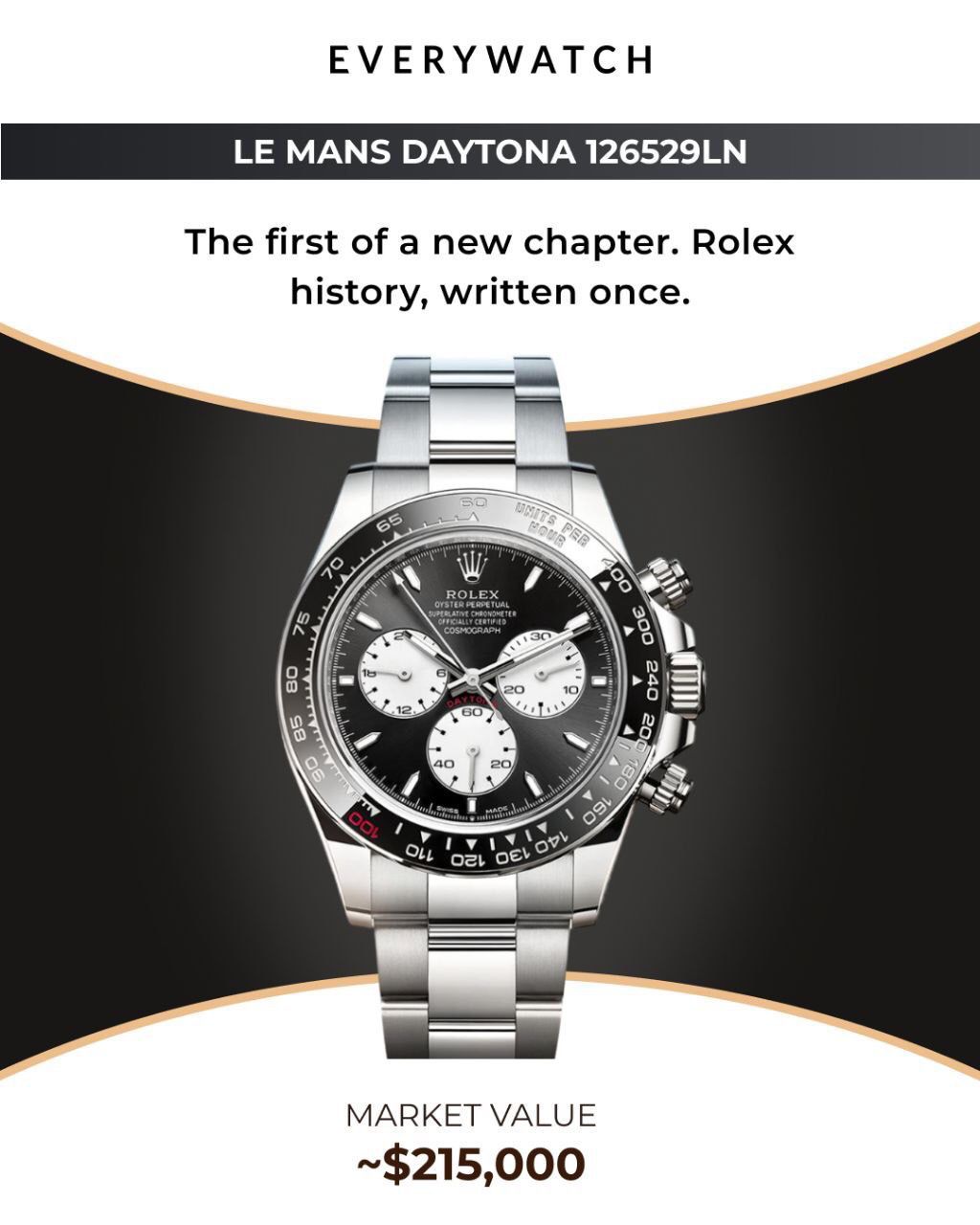
Daytona “Le Mans” 126529LN: White Gold
Current market: ~USD 215,000
The Le Mans Daytona marks one of the most explicit moments of self-reflection in modern Rolex history. Unlike incremental Daytona updates, this reference was created to commemorate Rolex’s own racing legacy—a conceptual move the brand had not made since the Paul Newman era.
At launch, the market failed to immediately grasp the importance of sequencing. The three metals were not introduced simultaneously, and only once the rollout neared completion did it become clear that the white gold version was not just another variant, but the anniversary reference, the one closest to the historical intent.
“People didn’t realize right away that the white gold was the actual historical piece. Once all the metals were out, that became clear—and that’s when the market started to move.”
This delayed recognition matters. Rolex rarely creates watches that explicitly reference its own mythology, and when it does, those pieces tend to age exceptionally well. The recent discussion around potential tricolor executions only reinforces how singular this reference may remain.
Day-Date “Puzzle Dial” 128238 & 128239: Yellow Gold & White Gold
Current market: ~USD 229,000 (YG) | ~USD 279,000–350,000 (WG)
The puzzle dial represents one of the most uncharacteristic design decisions Rolex has ever placed in its core catalog. Day-Dates traditionally symbolize continuity, formality, and restraint. Introducing a playful, almost abstract dial into that lineage was a conscious violation of Rolex’s own rules—and that initially made many collectors uncomfortable.
“A lot of people didn’t like it because it went so far off the beaten path. But that’s exactly why it matters.”
As allocations tightened, another reality became apparent: even highly placed collectors were not receiving these watches. That realization has driven demand decisively to the secondary market, particularly for the white gold version. History suggests that white gold Day-Dates with unconventional dials are often late bloomers. When the reassessment comes, it tends to be decisive.
.jpeg.jpeg)
Daytona 126518LN “Tiffany Dial": Oysterflex
Current market: ~USD 85,000–88,000
This is a rare case where the market largely got it right from the start. The turquoise dial immediately evoked comparisons to the so-called “Beach” Daytonas — watches that, despite once being niche, have since proven extremely resilient. The pairing with yellow gold and Oysterflex made the watch not just bold, but genuinely wearable.
“Everyone understood this watch immediately. It became iconic almost overnight.”
As deliveries increased, prices softened—a natural digestion phase rather than a loss of conviction. Historically, special-dial Daytonas tend to settle before being re-evaluated over time.
.jpeg.jpeg)
Daytona 126508 “John Mayer 2.0”
Current market: ~USD 82,000
The original green-dial Daytona was already a modern icon. This iteration refined it. At launch, some collectors preferred the familiarity of the first version. Over time, sentiment shifted. The updated dial tone, improved balance, and more mature execution gradually won consensus. That progression, hesitation followed by acceptance, is a familiar Rolex pattern. Icons rarely peak at introduction.
“People needed time with it. Once they did, many realized this version simply works better.”
.jpeg.jpeg)
Perpetual 1908 Platinum 52506
Current market: slightly below retail (~USD 45,000)
The platinum 1908 exists far outside Rolex’s mainstream narrative—and remains largely ignored as a result. Yet history suggests that non-sport, high-craft Rolex references often undergo delayed recognition. Certain Cellini and early chronograph variants followed this exact path: overlooked for years before being reconsidered as production realities became clearer. Platinum Rolexes are always produced in minimal numbers. Among them, the 1908 may ultimately prove one of the rarest.
“This watch will probably stay underappreciated for a long time. But from a collectability standpoint, it’s incredibly compelling.”
.jpeg.jpeg)
GMT-Master II 126729VTNR: White Gold, Left-Handed
Current market: ~USD 48,000
This reference combines several traits that Rolex almost never stacks together. Left-handed configuration is already rare. White gold GMTs have limited historical precedent. Adding a green dial creates a combination that feels almost experimental by Rolex standards. Refined collectors recognized this immediately. The broader market has not yet caught up.
.jpeg.jpeg)
Daytona 126500LN: Stainless Steel
Current market: ~USD 30,000
The 126500LN is not revolutionary—it is evolutionary, and that distinction matters. Subtle design cues referencing vintage Daytonas such as the 6263 give this watch a refinement the previous generation lacked. Market behavior already reflects this: the new reference trades at a consistent premium to the 116500LN. Over time, those preferences tend to solidify rather than reverse.
“That price gap exists for a reason. People clearly prefer the new generation.”
.jpeg.jpeg)
Land-Dweller Platinum 126736
Current market: ~USD 73,500
The Land-Dweller represents one of the most important technical expansions Rolex has made in years. Integrated bracelet, thin profile, new movement architecture—this is not a cosmetic launch. Early hype pushed prices sharply higher before retreating, a familiar Rolex cycle. Platinum executions of first-generation Rolex families have historically carried disproportionate long-term significance. The relative lack of competition for allocations today may not last.
.jpeg.jpeg)
Yacht-Master Titanium 226627
Current market: ~USD 23,500
While not Rolex’s first use of titanium, this is the first time the material has been applied to a truly wearable, everyday Rolex. The response was immediate and overwhelmingly positive. After an initial surge, pricing stabilized, still above retail, but supported by genuine demand rather than speculation. Material firsts at Rolex are rarely repeated quickly.
.jpeg.jpeg)
GMT-Master II 126710VTNR: Stainless Steel, Jubilee
Current market: ~USD 19,000
Left-handed GMTs were virtually absent from Rolex’s modern catalog prior to this reference. Compared to other steel GMT-Master II models, production is estimated to be a fraction, yet pricing remains broadly comparable. History suggests such gaps tend to close—slowly, then decisively.
.jpeg.jpeg)
Closing Thought
Rolex collectibility is not about speed. It is about pattern recognition, patience, and understanding how the brand behaves over decades. The watches discussed here sit in that quiet space where recognition has begun — but has not yet fully arrived.