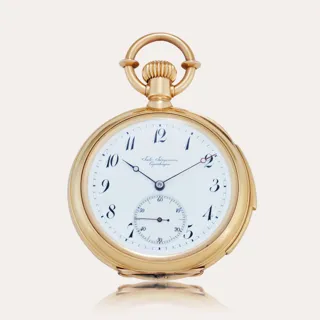
Jules Jürgensen, Copenhagen
A yellow gold open-faced keyless minute repeating watch, No. 15388, Circa 1890
Movement: nickel lever escapement, jeweled to the center, bi-metallic compensation balance, jeweled to the center carried in screwed gold chatons, two polished steel hammers repeating on coiled gongs, signed Jules Jürgensen, Copenhagen, No. 15388 Dial: white enamel dial, Arabic numerals, recessed subsidiary dial for constant seconds Case: 18k yellow gold, Jürgensen’s patented bow hand setting, repeating slide on the band, glazed cuvette, back lid engraved with monogram, case stamped with casemaker's initials JJ, and numbered 15388, cuvette engraved No. 15388, Jules Jürgensen, Copenhagen Signed: case, cuvette, dial and movement Diameter: 50 mm Accessories: Brazilian rosewood Jules Jürgensen original display box, original Certificate and rating paper, original instructions for hand setting, spare crystals, and one spare mainspringBorn in Le Locle on July 27, 1808, Jules Jürgensen would become one of the most distinguished watchmakers of the 19thth century . From an early age, he trained under the direct guidance of his father Urban Jürgensen, acquiring a solid foundation in horology. He continued his studies in Paris and London, where he trained under leading masters in physics, mechanics, and astronomy. This period of intensive study greatly shaped his approach to precision timekeeping. Upon returning to Le Locle, Jürgensen established a branch of his father's business, dedicating himself to the development of pocket chronometers. He spent his later years in Geneva, where he continued to refine his craft. Following his death, the business was carried on by his son, Jules F. U. Jürgensen, ensuring the continuation of the family legacy in fine watchmaking. In the years that followed, the company, with production facilities in Copenhagen and Le Locle, changed ownership several times, hindering long-term planning and strategic development. A turning point came in late 2014 with a fortuitous meeting with Søren Petersen, a Danish watch collector and businessman. Shortly thereafter, the Danish Private Investment Group, led by Petersen and five other investors, acquired the company after three decades of foreign ownership.