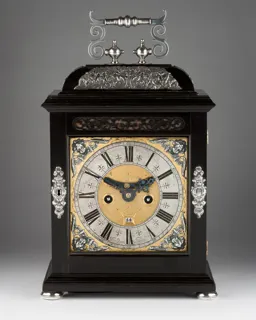
Daniel Quare, London, William & Mary Striking Table Clock, circa 1690
An exceedingly rare William & Mary silver-mounted ebony striking table clock with pull-quarter repeat, circa 1690.
Height : 13½ inches
Case : The case of archetypal Quare form, constructed on an oak carcass with ebony mouldings and veneers, with a dome top, surmounted by a Quare pattern scroll-ended handle with ring-turned baseplates, all in solid silver. The repoussé silver dome mounts are chased with foliage, scrolls and dolphin masks. The front door has matching repoussé double-mask escutcheons; the left pierced for the inverted spring lock, the top rail inset with a finely pierced ebony sound fret, while the mask behind has a matching fret. The rectangular glazed sides with conforming sound frets above, the inset rear door glazed and framed by mitred ebony D-mouldings. All above a finely moulded base plinth and resting on ring-turned solid silver bun feet
Dial : The 6½ inch square, fire-gilded, dial is engraved between the repousse silver winged-cherub spandrels, with lever above XII engraved s/n for strike/silent. The finely matted centre has a full-width decorated mock pendulum aperture, with matching date square below, the twin winding squares are framed by typical Quare ring-turned apertures. The silvered chapter ring has Roman hours with fancy half-hour markers, Arabic minutes within their division ring, and is signed Dan. Quare, London to either side of VI. The original blued-steel hands are sculpted with ring-turned bosses, while the dial-plate is held to the movement by three pinned dial feet
Movement : The substantial plates have six knopped and ring-turned pillars in Quare’s own pattern, the two trains have spring barrels and fusees with gut lines. The going train has a verge escapement with a short bob pendulum, while the strike train, governed by a rack and snail, sounds the hours on the largest bell. The pull-quarter repeat system is Quare’s own ‘parallel hammer’ design, peeling on four smaller, top-mounted bells, via a pull cord through the base. The backplate is superbly engraved with early tulips and scrolls and signed to the centre Daniel Quare, London. The lower section with typical early outside set-up click wheels to the barrels with a pierced and engraved brass retention click-spring. The movement is held in the case by two upper steel brackets, and seat-board steady pins
Provenance : Private collection UK, purchased from Watkins of London, 1954;
Private collection USA, 1998
Literature : Garnier and Carter, The Golden Age of English Horology, 2015, p.278 & 279;
Dzik, Beneath the Dial, English Clock Pull Repeat Striking, 1675-1725, 2023, p.262 to 264