Everywatch

Cartier

Description

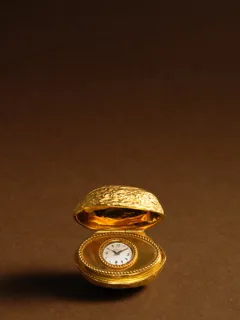
An unusual yellow gold purse watch in the form of a walnut, Circa 1958-59

Cartier, London An unusual yellow gold purse watch in the form of a walnut, Circa 1958-59 Dial: silvered dial signed Cartier, applied Arabic and faceted triangular hour indexes, dauphine hands Calibre: 6¾’’’ circular Jaeger-LeCoultre calibre signed Cartier Inc., damascened Côtes de Genève decoration, lever escapement, 15 jewels, annular balance with poising screws, flat hairspring, unadjusted Movement number: 1'142'858 Case: 9k yellow gold case cast in the form of a walnut, hinged and opening to reveal a broad ray-form fluted bezel with rope-twist effect borders itself hinged and containing the rear-wound watch Case number: outside case back with hand stamped numbering • 8661 • and 847, internal rim with London hallmarks and date letter ‘c’ for 1958-59 and [JC] Jean-Jacques Cartier punch mark Size: 39 mm length x 29 mm width Accessories: Cartier presentation box and travelling pouch Watches with cases cast in the form of objects had first found widespread popularity during the second quarter of the 17th century, when watch cases were available cast in a variety of forms including flower heads and animals. A small number of walnut watches were produced during the 19th century. The story of the gold Cartier London walnut is retold by Francesca Cartier Brickell in her book The Cartiers - The Untold Story of the Family Behind the Jewellery Empire. In her book, Cartier Brickell relays how her grandfather, Jean-Jacques Cartier, inspired by a bowl of nuts, decided to seek out a perfect specimen in order to have it cast in gold. Ever the perfectionist, it reportedly took three bags of walnuts before the ideal specimen emerged in Jean-Jacques hands. The gold walnut case was used by Cartier both as an empty pill box and as a housing for a purse watch. During the 1950s and 1960s there was a reaction by some designers against the classical watch shapes that had been established in the previous two decades. Unusual creative shapes were increasingly seen during the era, and Cartier in London were at the forefront of this design revolution, experimenting with a wide range of forms and styles.卡地亞 倫敦 獨特黃金胡桃形錢包錶,約1958-59年製 附帶盒子及旅行袋子

Similar Watches