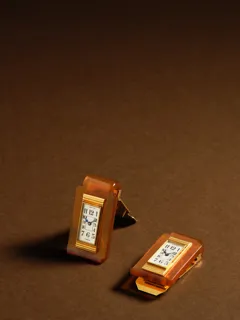
Cartier, Paris | An unusual yellow gold and bakelite easel-form clip watch, Circa 1930
Cartier, Paris
An unusual yellow gold and bakelite easel-form clip watch, Circa 1930
Dial: cream dial signed Cartier, France, black Arabic numerals, blued steel spade hands
Calibre: later 4½’’’ duoplan movement signed Jaeger-LeCoultre, soft metal movement cover, damascened Côtes de Genève decoration, lever escapement, 15 jewels, bi-metallic compensation balance with timing and poising screws, adjusted to three positions and temperature, flat hairspring
Case: 18k yellow gold baguette watch body with ribbed detailing, mounted within bakelite framework, integrated gold hinged clip to back, gold case back with notched rear-set winding crown
Case number: bezel interior, outside case back and underside of clip all with hand stamped numbers 24'599 and with French eagle’s head assay marks and [EJ] Edmond Jaeger punch marks, bezel interior, back of clip hand stamped 4'628 and with eagle assay, inside case back signed European Watch and Clock Co. Inc, France
Size: 39 mm length x 21.5 mm width
Accessories: none
This elegant clip watch, created by Cartier circa 1930, exemplifies the Maison’s ingenuity at blending practicality with luxury. Featuring an 18k gold case accented with bakelite, it was designed to be clipped onto a bag, purse, or directly onto clothing, combining functionality with refined aesthetics to transform a simple accessory into a statement of sophistication. Compact in size, its sleek design reflects the Art Deco sensibilities of the era, with clean lines, bold material contrasts, and a focus on geometric form. Its easel-style construction adds to its versatility, allowing the clip to hinge open so the watch can stand upright on a desk or table, making it an ideal travelling timepiece. Bakelite, developed in 1907 by Belgian chemist Leo Baekeland, was the first fully synthetic plastic. Valued for its durability, versatility, and ability to be moulded into intricate shapes, it became a defining material of the Art Deco period, often used in luxury goods, jewellery, and decorative objects. Its capacity to mimic natural materials such as tortoiseshell, while introducing modern colours and textures, made it a revolutionary choice for avant‑garde designs like this clip watch.卡地亞 巴黎 獨特黃金及電木立架式夾子腕錶,約1930年製