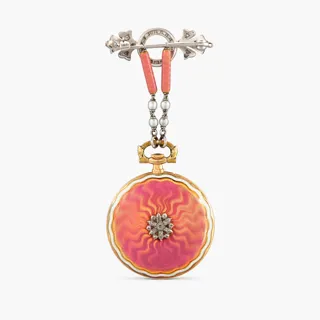
A yellow gold, enamel and diamond-set openface keyless lever pendant watch with matching short chain and platinum and diamond-set brooch, Circa 1905
Cartier, Paris A yellow gold, enamel and diamond-set openface keyless lever pendant watch with matching short chain and platinum and diamond-set brooch, Circa 1905
Dial: silvered sunburst patterned engine-turned dial, oval cartouche signed Cartier, Paris, Londres, stylised flower motif to the centre, black Arabic numerals, outer chemin-de-fer minute track, blued steel Breguet hands
Calibre: 10¼’’’ frosted gilded unsigned Swiss movement, lever escapement, bi-metallic compensation balance with timing and poising screws, flat hairspring, numbered 960, matching short pearl-set chain with two pink guilloché enamel rods joining the pendant chains to a platinum and diamond-set brooch with millegrain setting
Case: 18k yellow gold case, guilloché enamel case back of translucent pink enamel over ray-form engine-turning, central diamond-set star-form motif, opaque white enamel scalloped outer border, similarly scalloped front bezel, Art Nouveau chased and engraved bow, olivette for hand-setting to left side of pendant, inside case back and inner rim with French owl import assay marks
Case number: back scratch numbered 960
Size: 28.5mm diameter
Accessories: none
In the watch shown here, Fabergé’s influence on Cartier’s early watchmaking style is unmistakable. The pink gold guilloché enamel case back demonstrates a level of craftsmanship reminiscent of Fabergé’s exquisite objets d’art. The translucent enamel creates a luminous effect, allowing the intricate engine-turned pattern beneath to shimmer through – a hallmark of the guilloché technique perfected by the workshop of Henri Lavabre on Paris’s rue Tiquetonne. Renowned for his exceptional skill, Lavabre was integral to Cartier’s success in producing pieces of unparalleled refinement, and his workshop worked exclusively for Cartier between 1906 and 1921. At the centre of the case back, a diamond set star-form motif adds brilliance and symmetry, reflecting the opulent yet refined decorative style favoured by Russian aristocracy. The design is completed with an opaque white enamel border that frames the edge of the case back and is mirrored on the bezel surrounding the dial, creating a crisp contrast that accentuates the watch’s elegance.卡地亞 巴黎 黃金及琺瑯鑲鑽石吊墜懷錶,備短鏈帶及鉑金鑲鑽石胸針,約1905年製