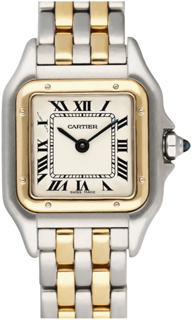
Cartier Panthere W25029B6 'Ladies' Two Row Stainless Steel Yellow Gold White Dial Quartz
The stainless steel case carries a yellow gold bezel secured by eight visible screws, with the characteristic sapphire cabochon crown completing Cartier's signature design detail at three o'clock. The cream dial presents bold black Roman numerals framed by an inner guilloché railroad border, with blued-steel sword hands at center and no date complication — keeping the dial composition entirely uninterrupted. The two-row bracelet alternates brushed stainless steel and polished yellow gold links. A Swiss quartz movement powers this piece. The reference W25029B6, the small 22-millimeter two-row configuration in stainless steel and 18-karat yellow gold, is the Panthère family's most intimate expression — a watch scaled to minimal wrist presence, designed to wear as much like a precious bracelet as a timepiece, and carrying the design's complete architectural vocabulary in its most concentrated form.Learn more When Cartier relaunched the Panthère in 2017 after nearly a decade of absence from the active catalog, the decision was received as both a cultural moment and a design vindication. The Panthère had never disappeared from the collecting conversation — if anything, its decade away from production had elevated its status among those who had worn it continuously and those who had discovered it through vintage channels — but its return to current production confirmed what that conversation had been suggesting for years: that the design belonged not to a specific decade but to a longer continuum of genuinely resolved formal ideas, and that the market for such ideas was not only present but actively hungry. The reference W25029B6, the small 22-millimeter two-row configuration in stainless steel and 18-karat yellow gold, is the Panthère family's most intimate expression — a watch scaled to minimal wrist presence, designed to wear as much like a precious bracelet as a timepiece, and carrying the design's complete architectural vocabulary in its most concentrated form.
The small Panthère occupies a specific and historically consistent role within the family's size hierarchy. At 22 millimeters, this is the configuration that pushes most deliberately against the boundary between watch and jewelry — a territory that Cartier has inhabited more naturally and more successfully than any other watch manufacturer, precisely because the maison's identity has always straddled that boundary from both sides simultaneously. The Panthère's case form — a softened square with rounded corners, the case body articulated with dimensional stepping, the bezel framed by its ring of eight small screws — retains its design integrity at 22 millimeters with a completeness that might surprise those who assume that good watch design scales primarily outward. The proportional relationships that make the Panthère legible and resolved at 27 or 30 millimeters are maintained at 22 precisely because the design was conceived as a coherent object rather than as a specification — the relative scale of the bezel to the dial, the screws to the bezel, the case to the bracelet, all hold their ratios at this smaller dimension, and the watch reads with the same formal clarity at intimate scale as it does at larger sizes.
The case is constructed in stainless steel for the body and lugs, with an 18-karat yellow gold bezel — the smooth, polished curved surface that provides the warm perimeter framing the dial — and the characteristic arrangement of eight small screws at the bezel's perimeter. These screws, inheritors of the Santos's original structural vocabulary, are rendered here in polished steel, their circular form providing detail punctuation at the transitions between gold and steel. The case finishing is entirely polished throughout, consistent with the Panthère's positioning as a jewelry watch rather than a tool watch — there is no brushing, no satin, no deliberate texture; the surfaces are mirror-finished, the better to catch and return light from every angle as the wrist moves. The crown is positioned at three o'clock in the characteristic Cartier recessed lug form, and its cap is set with a synthetic blue spinel cabochon — the deep blue rounded stone that Cartier has used to tip its watch crowns since the earliest Santos production, one of the maison's most persistent and most recognizable design signatures. The blue cabochon against the gold and steel of the Panthère case provides the single chromatic accent that prevents the composition from being entirely monochromatic — it is a small but deliberate gesture, entirely characteristic of Cartier's approach to the refinement of its own design vocabulary. Water resistance is appropriate to the watch's character: sufficient for the incidental contact of daily wear, not calibrated for aquatic contexts.
The dial, as in all Panthère configurations, is the design's essential achievement. The ivory-toned lacquer ground — that particular warm white that reads neither as stark contemporary white nor as the aged cream of true vintage patina, but as something calibrated and deliberate between them — provides the backdrop for Cartier's Roman numeral typography in its most concentrated application. The numerals at the twelve, three, six, nine, and intermediate positions are drawn in bold, high-contrast black, their scale filling the available space with the graphic confidence that Cartier has maintained as a consistent typographic standard across more than a century of dial production. At 22 millimeters, the numerals' relative scale to the dial's total area is higher than in larger configurations — the dial is more fully occupied, the typography more intense — which gives the small Panthère's dial a quality of compression that reads as richness rather than crowding. Inside the Roman numerals, the rope-twist decorative border encloses the inner dial field, its cable motif providing the dimensional texture that distinguishes the Panthère's dial from the purely flat constructions of lesser watch designs. Within this inner border, only the "Cartier" signature at the top and the blued-steel hands occupy the space — an economy of elements that would read as austerity in any other context but which here reads as precision, everything present serving a necessary visual function. The blued-steel lancet hands — slender, tapered, their deep blue-black tone providing maximum contrast against the ivory ground — complete the dial's restrained color program with the same chromatic authority as the crown's sapphire cabochon, both elements drawing from the same cool blue register against the warmth of the surrounding gold and ivory.
The movement is a quartz calibre, and the choice is consistent with everything about the Panthère's identity at this scale and in this configuration. A 22-millimeter watch whose priorities are jewelry-adjacent wearability, minimal visual intrusion, and the kind of long-term reliability that allows it to become a permanent and unquestioned part of daily life is precisely the context for which quartz movement technology is most naturally suited. The calibre's accuracy is absolute within the demands of daily timekeeping, its maintenance intervals measured in years rather than the months of a mechanical movement requiring regular winding, and its thin profile allows the case to maintain the slim, jewelry-appropriate depth that the Panthère's design requires. These are not compromises; they are specifications that align precisely with the watch's intended role, and Cartier has never suggested otherwise.
The bracelet in the two-row configuration is the W25029B6's defining structural contribution. The two-row construction — alternating rows of steel outer links and yellow gold center links, the links rounded and supple in their articulation — is scaled precisely to the 22-millimeter case, the bracelet's width transitioning naturally from the case lugs and maintaining proportional consistency throughout its length. The gold center links are polished to a warm, bright mirror finish, and the steel outer links are polished to a complementary slightly cooler tone, the two materials' different light behaviors creating the visual alternation that is the Panthère bracelet's most immediately recognizable characteristic. The bracelet's flexibility — the remarkable suppleness of its articulation that allows it to conform to the wrist with a fluid ease approaching that of a metal fabric — is as impressive at this scale as in the larger configurations, the small links articulating individually to create the overall movement. This quality transforms the Panthère from a watch worn on the wrist to a watch that inhabits the wrist, its presence felt as a natural extension of the wrist's own movement rather than as an imposed structure. A concealed folding clasp, integrated into the bracelet's underside and invisible from the front, secures the bracelet while maintaining the visual uninterrupted continuity of the link design around the wrist.
Among collectors engaging with the relaunched Panthère, the small two-row configuration holds a particular position. The 2017 relaunch affirmed that the design's relevance was not contingent on scale — that 22 millimeters, a dimension that other manufacturers have largely abandoned as insufficient for contemporary tastes, remains entirely viable when the design inhabiting it is genuinely resolved and the material quality is genuine. The W25029B6 is the Panthère for the wearer who has considered the options across the size range and concluded that the design's smallest expression is, for their wrist and their purposes, also its most complete one — a watch that wears with the ease of jewelry and the permanence of something that has already proven, across decades of continuous wearing by its most devoted admirers, that it intends to outlast every trend that surrounded its creation.