PAUL PHILIP BARRAUD
No. 2 / 650
PAUL PHILIP BARRAUD
No. 2 / 650
Around 1800
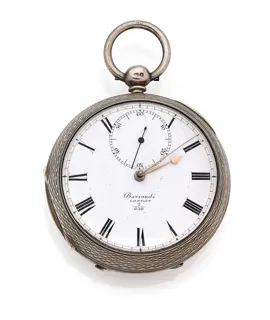
Chronometer type silver watch
Case: round, guilloché, double hinge with opening on the back for key winding
Dial: enamel, Roman numerals, railroad, small second hand, signed "Barraud's London 2/650"
Movement: Earnshaw-type detent escapement, balance bridge with pierced decoration, cylindrical hairspring balance, fusee and chain, signed "Barraud's Cornhill London 2/650"
Diam. / Gross weight: 57mm / 155.57g.
Please note that the movement does not run and requires servicing. Artcurial cannot be held responsible for any repair costs. This watch is sold as is
A silver pocket chronometer with detente escapement
Please note that the movement not running and needs an overhaul. Artcurial will not be held responsible for any repairs should they be required. This watch is sold "as is"
Provenance: Former Georges Baptiste Collection
Comment: Paul Philip Barraud was admitted to the Clockmaker's Company in London in 1796 and became a Master around 1810. He will remain famous in the history of watchmaking, in particular for having developed, with the help of William Howel and George Jamison, a version simplified version of the famous marine chronometers of the famous Thomas Mudge. One of them is kept at the Patek Philippe Museum in Geneva.
Estimate 3,000 - 4,000 €
€3,250
* Results are displayed including buyer's fees and taxes. They are generated automatically and can be modified.PAUL PHILIP BARRAUD
No. 2 / 650
Around 1800
Chronometer type silver watch
Case: round, guilloché, double hinge with opening on the back for key winding
Dial: enamel, Roman numerals, railroad, small second hand, signed "Barraud's London 2/650"
Movement: Earnshaw-type detent escapement, balance bridge with pierced decoration, cylindrical hairspring balance, fusee and chain, signed "Barraud's Cornhill London 2/650"
Diam. / Gross weight: 57mm / 155.57g.
Please note that the movement does not run and requires servicing. Artcurial cannot be held responsible for any repair costs. This watch is sold as is
A silver pocket chronometer with detente escapement
Please note that the movement not running and needs an overhaul. Artcurial will not be held responsible for any repairs should they be required. This watch is sold "as is"
Provenance: Former Georges Baptiste Collection
Comment: Paul Philip Barraud was admitted to the Clockmaker's Company in London in 1796 and became a Master around 1810. He will remain famous in the history of watchmaking, in particular for having developed, with the help of William Howel and George Jamison, a version simplified version of the famous marine chronometers of the famous Thomas Mudge. One of them is kept at the Patek Philippe Museum in Geneva.
Estimate 3,000 - 4,000 €
€3,250
* Results are displayed including buyer's fees and taxes. They are generated automatically and can be modified.